cope posting as market signal
what people say when their bags are down tells you more than what they say when bags are up.
you can learn more about market psychology from cope posts than from price charts.
when bags are up, everyone sounds the same: bullish, confident, vindicated. when bags are down, the coping mechanisms differentiate. and those differences are signal.
the cope taxonomy
i've identified distinct coping patterns. each tells you something different about holder psychology and probable behavior.
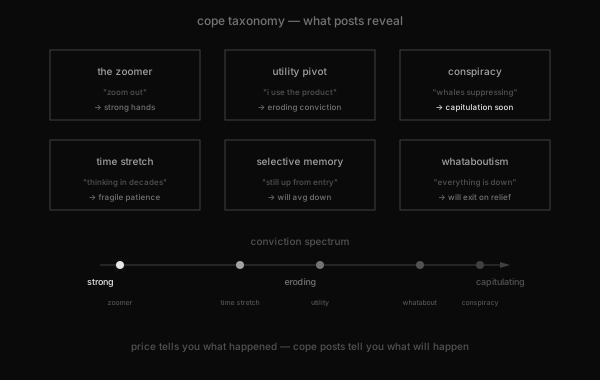
the zoomer
"zoom out. look at the yearly chart. we're still up 400%."
signal: holder has high conviction but is feeling pain. unlikely to sell at current prices. will hold through more pain.
implication: strong hands. supply is locked.
the utility pivot
"price doesn't matter. i use the product every day. fundamentals are strong."
signal: shifting from investment thesis to usage thesis. rationalization in progress.
implication: will hold longer than rational, but conviction is eroding.
the conspiracy
"whales are suppressing price. manipulation is obvious. once they're done accumulating..."
signal: needs external explanation for losses. can't accept market is simply not interested.
implication: unstable hands. one more leg down triggers capitulation.
the time horizon stretch
"i'm thinking in decades. this is generational wealth. i don't check price anymore."
signal: already checked price. checking price constantly. trying to detach.
implication: fragile conviction dressed as patience.
the selective memory
"i'm still up from my entry. you don't lose until you sell."
signal: anchor bias in full effect. probably underwater on recent buys but fixated on oldest position.
implication: will average down until broke or capitulate suddenly.
the whataboutism
"everything is down. btc is down. the whole market is red. it's not just us."
signal: seeking comfort in shared pain. not addressing project-specific issues.
implication: will sell when market recovers and this one doesn't.
why cope posting is useful
cope posts reveal:
- conviction distribution — how many are true believers vs tourists?
- capitulation proximity — how close is the community to giving up?
- narrative health — is the story still compelling or are people stretching?
- supply dynamics — are hands strong or weak?
price tells you what happened. cope posts tell you what will happen.
reading the timeline
during drawdowns, i sample community timelines and categorize cope types. rough heuristics:
- mostly zoomers → floor is probably near
- mostly conspiracies → more pain coming
- mostly utility pivots → slow bleed likely
- mostly time horizon stretching → community is tired but not dead
- mostly silence → either capitulation or extreme diamond hands
the absence of cope is also signal. when communities stop coping and just go quiet, something is about to happen.
the inverse: euphoria posting
euphoria posting is the opposite but equally informative:
- "life changing" posts → local top
- "quit my job" posts → definite local top
- attacking other communities → peak fragility
- price predictions with specific numbers → maximum cope forward
when your timeline fills with euphoria, it's time to think about exits.
implications
sentiment analysis works, but you have to read the right signals. cope posting is:
- real-time (no lag like on-chain metrics)
- granular (individual psychology visible)
- predictive (behavior follows psychology)
the timeline is a sentiment indicator. you just have to learn to read it.