neet vs seet
the great inversion: how 'not in education, employment, or training' became aspirational.
somewhere along the way, NEET stopped being a diagnosis and started being a flex.
NEET—Not in Education, Employment, or Training—was originally a policy term. a way to categorize young people who had fallen through the cracks. a problem to be solved.
then the internet got hold of it.
the inversion
in crypto culture, NEET became something else entirely. it became:
- freedom from the wage cage
- rejection of credentialism
- proof of alternative viability
- a lifestyle aspiration
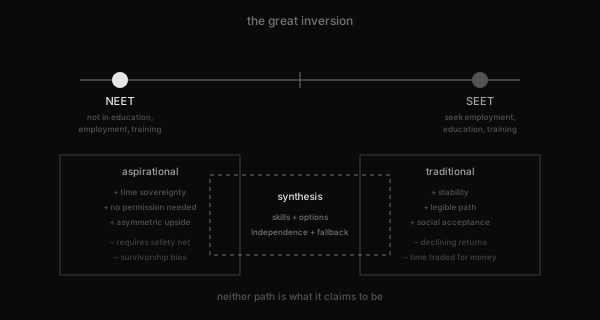
the counterpart emerged: SEET—Seek Employment, Education, Training. the normie path. the thing you're supposed to do. the thing NEETs have opted out of.
SEET is grinding for grades. SEET is updating your linkedin. SEET is optimizing for someone else's approval.
NEET is... not doing that.
why NEET became aspirational
the traditional path stopped delivering.
you get the degree. you get the job. you're still broke, still stressed, still trading time for money with no end in sight. the promise was a lie. everyone can see it now.
crypto offered an alternative: make money from your laptop without anyone's permission. no resume. no interview. no boss. just you and the market.
NEET went from "failed to launch" to "opted out on purpose."
the guy who never got a real job but aped into the right token at the right time? he's living the dream now. the guy who spent six years getting credentials? he's making payments on his debt.
which one is the failure?
the honest version
here's what NEET actually looks like:
the aspirational version: financial independence through smart positioning, time sovereignty, pursuing what matters without external constraints
the real version: checking charts at 4am, parasocial relationships with anon accounts, atrophied social skills, uncertain income, no health insurance, explaining to family why you don't have a job
SEET has its own honest version:
the aspirational version: stability, growth, expertise, contribution, building something real
the real version: meetings about meetings, performing busyness, being a line item on someone else's spreadsheet, golden handcuffs, the sunday scaries
neither path is what it claims to be.
the privilege layer
there's something uncomfortable here: viable NEET usually requires a safety net.
living with parents. savings to burn. family money. the ability to survive a long losing streak.
the loudest NEET voices often have invisible support structures. "i don't need a job" hits different when there's a trust fund underneath.
SEET doesn't require privilege. it just requires compliance. that's why most people do it. not because they love it. because the alternative isn't actually available to them.
the identity trap
both paths become traps when they become identities.
NEET-as-identity means you can never take a job without feeling like a sellout. even if you need to. even if you want to. the identity forecloses the option.
SEET-as-identity means you can never stop grinding without feeling worthless. your value is your productivity. rest is laziness. the identity owns you.
the healthiest people move between states without making either their whole personality.
what it actually reveals
the NEET vs SEET discourse reveals something about the current moment:
institutions are losing legitimacy. the traditional path no longer guarantees the traditional outcomes. people are looking for alternatives.
but alternatives are risky. most NEETs don't make it. the ones you see are survivorship bias. the ones you don't see went back to SEET with nothing to show for it.
the truth is: there's no safe path anymore.
SEET offers declining returns on increasing investment. NEET offers optionality with no floor.
pick your poison.
the synthesis
the real move might be neither pure NEET nor pure SEET.
it's having enough SEET to survive—skills, connections, fallback options—while maintaining enough NEET to stay free—time for asymmetric bets, space to think, independence from any single institution.
the worst version is NEET without positioning or SEET without boundaries.
the best version is choosing what you do each day because you want to, not because you have to, while knowing you could do something else if you needed to.
that's the actual freedom. not NEET. not SEET. just options.
most people have fewer options than they think. the goal is having more.