the pump.fun reality
what actually happens when you launch. why organic looks like rugs. why devs aren't what you think.
i've launched a lot of tokens. some went to 30 million. some didn't hit 15k. same person, same effort, same mechanics. the difference was never me. the difference was attention.
people don't understand this. they think rugs are malicious. most aren't. most are just attention dying.
how pump.fun actually works
when you launch on pump.fun, the mechanics are simple:
- you create a token (30 seconds, minimal cost)
- the bonding curve starts
- if enough buys happen, it graduates to raydium
- if not, it dies on the curve
there's no special advantage for the deployer. no pre-allocated tokens. no hidden wallets. everyone buys on the same curve.
this is important: the "dev" is just the first buyer.
why organic looks like rugs
here's what people get wrong:
an organic launch with no coordination will often:
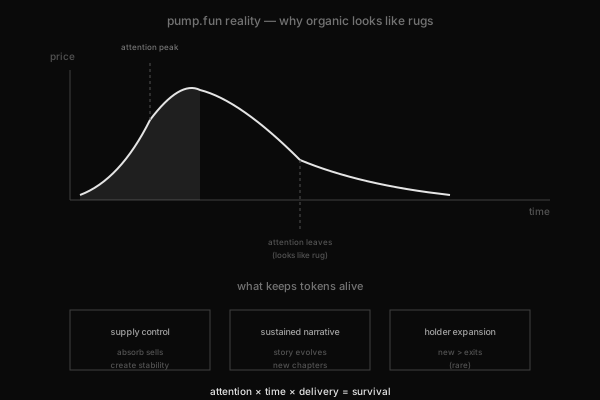
- spike on initial attention
- lose momentum as attention shifts
- bleed down as early buyers exit
- eventually die
this looks identical to a rug. but it's not. there was no malicious exit. there was just... no more attention.
attention is the oxygen. when it leaves, the token dies. that's not a rug. that's nature.
what keeps tokens alive
i've seen three patterns that keep tokens alive past the initial spike:
supply control — someone (or a coordinated group) holds enough supply to prevent spiral selling. they absorb sells. they create stability. this is expensive but effective.
sustained narrative — the story keeps evolving. new chapters. new events. new reasons to pay attention. the token becomes a living thing with plot.
exponential holder expansion — new holders keep arriving faster than old holders exit. this is rare and usually requires external catalysts (influencer posts, news events, viral moments).
most tokens have none of these. so most tokens die. that's not failure. that's base rate.
the creative reality
i treat this as creative work. it's like drawing an image or producing music.
you put something into the world. sometimes it resonates. sometimes it doesn't. you can't control resonance. you can only control craft.
i've run the same narrative concept seven days in a row. different results every day. tuesday hits 2 million. wednesday doesn't graduate. same idea, same execution.
the variable isn't you. the variable is the collective attention state of thousands of people at that exact moment.
the dev misconception
people have a completely wrong view of devs.
they think devs are a separate category. malicious actors distinct from "the community." this is fiction.
the reality:
- daily runners come from serial launchers
- daily runners come from teams with blue-checked twitter accounts
- daily runners come from complete randoms
- daily runners come from elon posting something weird
it's all the same pool of people. the "dev" launching your favorite coin is the same person launching the one that rugged you. the difference was attention, not intention.
when elon posts a mecha hitler image and someone launches that token and it goes to 0, nobody calls them a scammer. when someone launches an original concept and it goes to 0, suddenly they're a rugger.
same mechanics. same outcome. different narrative about the person.
tracked wallets
people obsess over tracked wallets. they think copy-trading known wallets is edge.
it's not. it's already priced in.
by the time you see the buy, others have seen the buy. the tracked wallet IS the pump. you're not following alpha. you're providing exit liquidity.
the wallets that matter aren't tracked. the moment a wallet gets tracked, its edge disappears.
the honest position
i've made a lot of money doing this. i've also roundtripped a lot of money. watched millions go back to zero because i believed too hard or moved too slow.
that's the game. you're not entitled to keep what the market gave you. you have to earn it again every day.
the haters come with the territory. everyone has them. if you're doing anything visible, someone will hate you for it. this is constant whether you're launching tokens or making music or posting opinions.
you can't optimize for their absence. you can only optimize for your own clarity.
the formula
it's actually simple:
attention × time × delivery = survival
- attention: are people watching?
- time: can you sustain it?
- delivery: are you giving them reasons to stay?
most launches fail on attention (never got it) or time (couldn't sustain it) or delivery (nothing new happened).
the ones that work nail all three. and sometimes you nail all three and it still doesn't work because the market wasn't ready.
that's fine. launch again tomorrow.
the real take
memecoins aren't investments. they're not companies. they're not even communities really.
they're attention experiments. cultural tests. live market research on what resonates.
some experiments work. most don't. the experimenter isn't evil when experiments fail. they're just experimenting.
the sooner people understand this, the sooner we can have honest conversations about what this actually is.
it's creative work with financial outcomes. nothing more. nothing less.